
WooCommerce vs Shopify: An Honest Comparison for 2026
This is the most common question we receive from store owners: WooCommerce vs. Shopify? Well, the honest answer is that there isn't a clear winner between the two. Both platforms solve different problems for different businesses. We've built stores on both platforms, migrated stores from both platforms to the other, so we thought we'd give you a no-holds-barred comparison with no agenda. If you're looking for a Shopify alternative or wondering if open source ecommerce is for you, we've got the inside scoop.
The Fundamental Difference
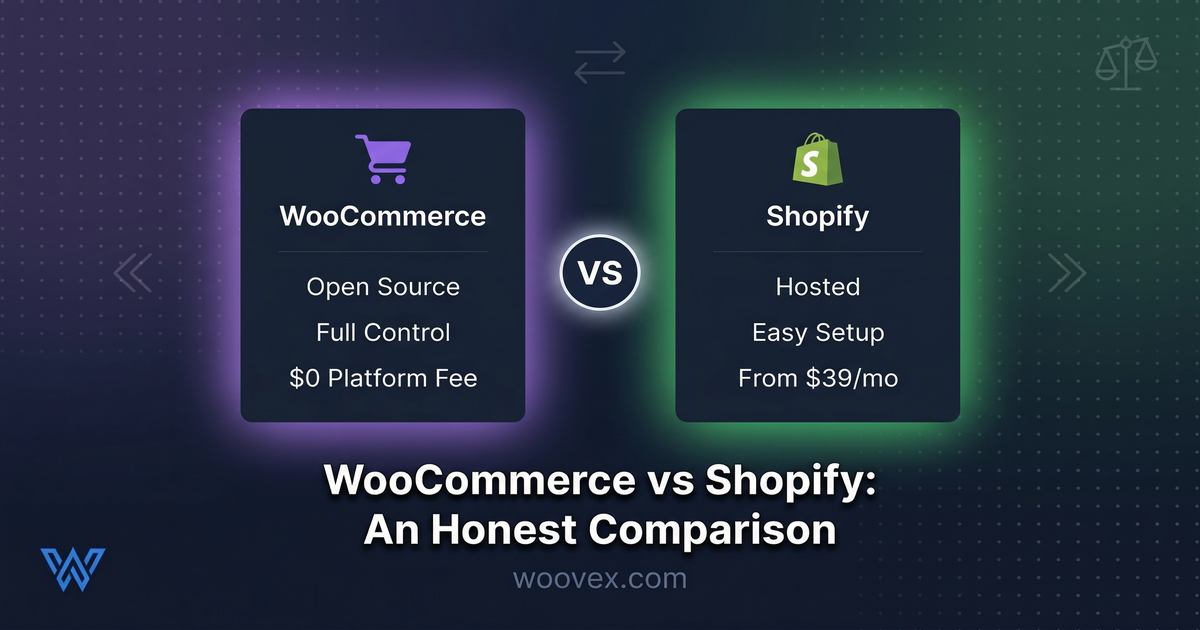
Shopify is a hosted solution. You sign up, pick a theme, add your products, and go live. Shopify handles hosting, security, updates, and payment processing. You pay a monthly fee for this ease of use.
WooCommerce, on the other hand, is a plugin for WordPress. You host it yourself, control every aspect of your store, and own your entire code base. More control, more headaches. This concept of an open source ecommerce solution is one of the biggest advantages of WooCommerce for businesses.
Think of it like Renting a House vs Buying a House. Shopify is a nice apartment where someone else handles maintenance. WooCommerce is a house you own, where you can knock down walls and add a wing, but you also have to fix your own plumbing.
Cost Comparison
Shopify costs:
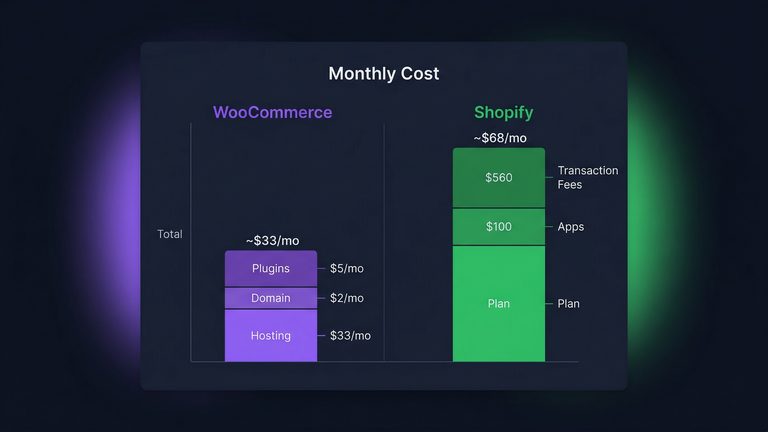
- Basic plan: $39/month ($468/year)
- Shopify plan: $105/month ($1,260/year)
- Advanced plan: $399/month ($4,788/year)
- Transaction fees: 0.5-2% if not using Shopify Payments
- Apps: most useful ones cost $10-$100/month each
WooCommerce costs:
- Software: $0 (open source)
- Hosting: $30-$300/year
- Domain + SSL: $14-$50/year
- Theme: $0-$79 one-time
- Plugins: $0-$500/year
- Transaction fees: only from your payment gateway (typically 2.9% + $0.30)
For most small to medium-sized stores, the cost of WooCommerce will be $300 to $1,500 per year. The cost of Shopify's equivalent will be $1,000 to $3,000 per year. There are no additional platform or transactional fees with WooCommerce.
The cost disparity will be larger for larger stores. For a store that does $500K per year on Shopify's basic plan, the transactional and platform fees will be $10,000+. For a WooCommerce store, the cost of the hosting could be up to $600 per year. There will be no percentage cut. We break down the full picture in our WooCommerce cost breakdown, which covers hosting, plugins, and development costs in detail.
Ease of Use
Shopify takes the prize here. There's no getting around it. You can set up a basic Shopify store in an afternoon without any technical knowledge whatsoever. The dashboard is clean, the theme editor is visual, and everything works out of the box.
With WooCommerce, the learning curve is a bit higher. You need to set up a host, install WordPress, set up the plugin, etc. Again, not rocket science by any means, but not as easy as Shopify by a long shot.
Of course, once you've got both stores set up, the day-to-day usage of the store is roughly the same level of difficulty. The difference comes in the ease of getting the store set up in the first place. Many users of the WooCommerce platform who have come from a Shopify background comment that the learning curve pays off within weeks.
Flexibility and Customization
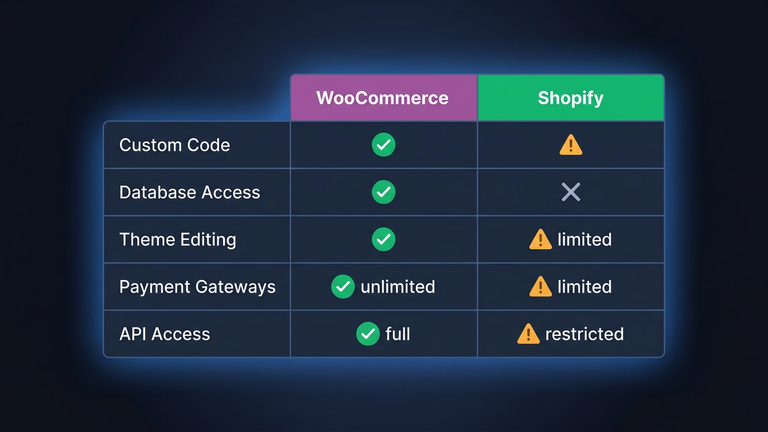
WooCommerce wins hands down here. s an open-source solution, you can change literally anything. Want custom product types? Go for it. Want a custom checkout flow? Easy. Want to integrate with third-party solutions? You bet. Want complex pricing rules? Role-based pricing for B2B? Multi-vendor marketplaces? If you can code it, WooCommerce can do it.
Shopify offers customization within their ecosystem. Liquid templates, Storefront API, and Shopify Functions provide a decent level of flexibility. However, there are some things that simply cannot be done within Shopify.
Examples of custom solutions that WooCommerce can do, which Shopify cannot (or makes extremely difficult):
- Custom product configurators with real-time pricing
- Complex B2B pricing with role-based discounts
- Deep integration with legacy ERP or inventory systems
- Custom subscription logic beyond standard recurring billing
- Full control over checkout field layout and validation - see how WooCommerce checkout customization can transform your conversion rates
SEO and Content
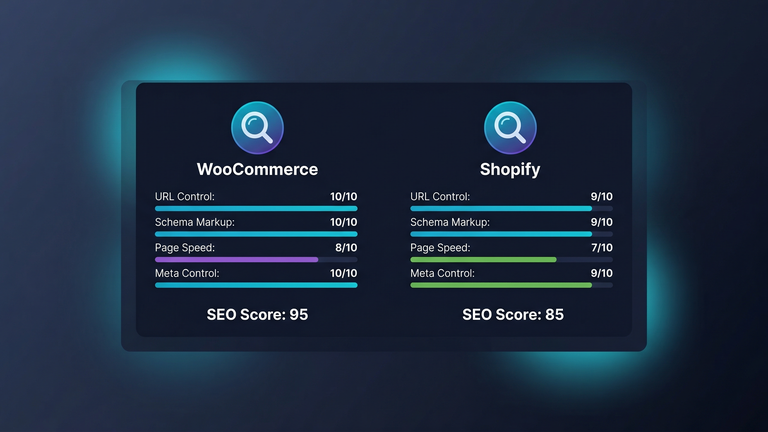
WooCommerce wins this round too. It inherits this advantage from WordPress, as it is a content-focused platform by design. You have full control over your site’s URL structure, meta tags, schema, and more. Plugins like Yoast SEO or Rank Math give you granular control over every page.
Shopify’s SEO is good, but it’s not perfect. While you do have some control over your site’s URL structure, it’s limited by Shopify’s /collections/ and /products/ prefixes. Similarly, blog functionality is not as advanced as it is in WordPress. You also have limited control over technical SEO features like robots.txt, site maps, and redirects.
This is another area where WooCommerce is more suitable if your business relies heavily on content marketing and SEO in general. It’s a key reason why people switch from Shopify to WooCommerce in the first place.
Performance and Reliability
Shopify is more reliable right out of the box. hey provide hosting, CDN, and caching. Your site will be fast and running 99.98% of the time without any work on your part.
WooCommerce performance is totally dependent on your hosting and setup. A poorly set up WooCommerce site on bad shared hosting can be painfully slow. However, a well optimized WooCommerce site on good managed hosting can be just as fast or even faster than Shopify. We cover the specific techniques in our guide to WooCommerce speed optimization.
The difference: Shopify gives you a floor you can't go below. WooCommerce gives you a ceiling you can reach, and a floor you can fall through if you're not careful.
AI and Future-Proofing
This is where WooCommerce is increasingly excelling. Since you have access to your data, you can use any AI model, connect to any API, or build any feature that doesn't currently exist in any app store.
Shopify is now offering AI tools. These tools are Shopify tools on Shopify's schedule. You cannot customize them. You think AI is going to revolutionize the way people shop? It will. You need to have complete access to the AI tools for your store. We explore the landscape in depth in our post on AI in ecommerce.
With WooCommerce, you can use AI tools that you want, OpenAI, Claude, Gemini, or others. You can build your own recommendation engines on your data. You can build AI-powered chatbots that ask the actual questions of your actual inventory. You can build dynamic pricing tools that respond to your actual market. You cannot do any of those things on Shopify. These are the advantages of WooCommerce over Shopify in AI tools. These will only continue to grow in importance.
So Which One Should You Pick?
Choose Shopify if:
- You want the simplest possible setup
- You are not tech-savvy and don’t want to deal with hosting
- Your online store is simple (standard products, standard checkout)
- You want ease of use over flexibility
- You are into dropshipping or want to validate a product idea
Choose WooCommerce if:
- You want features not possible with plugins
- SEO and content marketing are your online strategy
- You want to own your data and code completely
- You need complex pricing, subscriptions, or B2B features
- You're building for the long term and want full control
- You want to integrate with AI and other systems
And And if you're currently on Shopify and finding that it's not able to handle your business, we can definitely move your store over to WooCommerce. This includes all products, orders, customers, and even SEO data. We've done this for stores that have 10 products as well as stores that have 50,000 products. We offer a full platform migration service service that includes zero downtime.
Thinking About Moving to WooCommerce?
We help with migrations from Shopify, Magento, and BigCommerce to WooCommerce. No downtime, complete transfer, and SEO intact.